|
Nu?
What's New? Gary Mokotoff, Editor Volume 14, Number 7 | February 17, 2013 Every
government puts value on preserving its history. That is why we have
national archives. Genealogy preserves history; the history of a
family. It cannot be done without access to records, just as historians
cannot preserve a nation's history without access to records. It is a
greater good than the right to privacy. It is a greater good than the
risk of identity theft.
Past issues of Nu? What's New? are
archived at http://www.avotaynu.com/nu.htm
|
|||||||
|
JRI-Poland
Signs New Agreement with Polish State Archives
Jewish Records Indexing - Poland (JRI-Poland) has entered into a new multi-year agreement with the Polish State Archives (PSA) to expand access to Jewish records. JRI-Poland now has indexed more than 4.5 million records—primarily birth, marriage and death records—and expects the number to grow to 5.5 million by the end of the year. At the same time, PSA announced that they are beginning a massive effort to digitize all vital records—independent of religion—in their more than 30 regional archives. These will be available at no charge on their National Digital Archives and Regional Archives websites.  JRI-Poland
plans to link its search results to these PSA’s digital
images of
Jewish records. As a result of the massive indexing undertaken by
JRI-Poland since 1995, the indices to Jewish records will form the bulk
of all digital image linking on the PSA website. Thus, for the first
time, a non-profit organization will be linking its search results to
vital record images provided by a European archives. JRI-Poland
plans to link its search results to these PSA’s digital
images of
Jewish records. As a result of the massive indexing undertaken by
JRI-Poland since 1995, the indices to Jewish records will form the bulk
of all digital image linking on the PSA website. Thus, for the first
time, a non-profit organization will be linking its search results to
vital record images provided by a European archives.In addition, JRI-Poland and the PSA will institute a new order processing system to simplify the process of obtaining copies of archival records. JRI-Poland will have the administrative responsibility for processing orders for records from branches of the Polish State Archives. Researchers will be able to place orders by clicking on record index entries of interest in the JRI-Poland search results and paying by credit card via the JRI-Poland website. The order processing system will eventually be phased out as digitized records become available online. The complete announcement can be found at http://www.jri-poland.org. FamilySearch Removes Online Cook County Images of Vital Records While the agreement with JRI-Poland and the Polish State archives is a major step forward in public access to vital records, FamilySearch has run into yet another problem with their plan to digitize all their microfilm records and allow free public access at their Internet site. Under a newly revised contract with Cook County, Illinois (Chicago), they have removed all images of vital records for the county from their website. People can get copies of these vital records by paying Cook County, or at no charge by using the FamilySearch Photo Duplication Service mentioned in the last issue of Nu? What’s New? Previously the French government asked FamilySearch to remove all digital images from the FamilySearch site and “France” is conspicuously missing from the list of countries in Continental Europe on the FamilySearch home page. Aaron Lansky To Be Keynote Speaker at Annual Conference 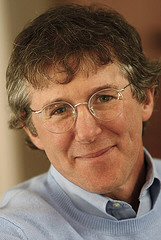 Aaron
Lansky, founder and president of the Yiddish Book Center
in Amherst, Massachusetts, will be the keynote speaker at the 33rd
IAJGS International Conference on Jewish Genealogy to be held in Boston
from August 4–9. Lansky is responsible for revitalizing the
study
of the Yiddish language and motivating hundreds of young scholars to
study and teach Yiddish. He has saved more than a million Yiddish books
since he started collecting them as a 23-year old graduate student in
1980. His mission to rescue Yiddish literature earned him a MacArthur
Foundation "Genius Grant" in 1985. Aaron
Lansky, founder and president of the Yiddish Book Center
in Amherst, Massachusetts, will be the keynote speaker at the 33rd
IAJGS International Conference on Jewish Genealogy to be held in Boston
from August 4–9. Lansky is responsible for revitalizing the
study
of the Yiddish language and motivating hundreds of young scholars to
study and teach Yiddish. He has saved more than a million Yiddish books
since he started collecting them as a 23-year old graduate student in
1980. His mission to rescue Yiddish literature earned him a MacArthur
Foundation "Genius Grant" in 1985.By collecting books once destined for dumpsters, Lansky has been able to establish or strengthen Yiddish collections at 700 libraries in 26 countries. With help from Steven Spielberg, his Yiddish Book Center has digitized most of its collection, including many yizkor books, and posted them online. The Center now sponsors a range of educational and cultural programs that not only preserve Yiddish culture of the past but also bring it to younger generations for the future. Lansky told the story of his lifelong work in his book, "Outwitting History", which was awarded the Massachusetts Book Award in Non-Fiction. Lansky will speak at the opening plenary session on Sunday evening, August 4th. He also will be available to meet with attendees at a Breakfast with the Experts. A special bus tour to the Yiddish Book Center will be offered during the conference. Besides the keynote speaker, there will be 200 lectures, workshops and demonstrations at the conference. Access to subscription databases at no cost and help in translating documents will be available in the Resource Center. There also will be hands-on computer workshops and an Exhibitors’ Hall with the latest tools to facilitate family history research. Over 1000 researchers, from beginners to experts, are expected to attend. Register now at http://www.iajgs2013.org. An early-bird discount is available until April 30. Reservations for the conference hotel, the historic Boston Park Plaza Hotel, also can be made at the same conference website. National Library of Australia Digitizing Additional Newspapers The National Library of Australia has posted a list of newspapers they will be digitizing during 2013 at http://www.nla.gov.au/content/new-titles-coming. The Library states that exact dates when a named newspaper will be available cannot be made at this time. The project has been underway since 2008. The service includes newspapers published in each state and territory from the 1800s to the mid-1950s. To date, more that 350 different newspapers have been digitized. They are listed, with years covered, at http://trove.nla.gov.au/ndp/del/titles. IIJG Issues Annual Call for Research Proposals  The
International Institute for Jewish Genealogy (IIJG) has issued its
annual Call for Research Proposals for original research in the field
of Jewish genealogy to be carried out in the academic year of
2013–14. Successful applicants will be awarded grants of up
to
$10,000. The
International Institute for Jewish Genealogy (IIJG) has issued its
annual Call for Research Proposals for original research in the field
of Jewish genealogy to be carried out in the academic year of
2013–14. Successful applicants will be awarded grants of up
to
$10,000.Proposals are requested by May 31, 2013. Proposals meeting strict standards of academic excellence will be judged by the extent to which they broaden the horizons of Jewish genealogical research and/or create innovative tools or technologies to assist Jewish genealogists and family historians in their work. Submission instructions are at the IIJG website, http://www.iijg.org, under Research/Research Grants. Successful applicants will be announced on September 1, 2013. ROM-SIG Plans to Index Bucharest Jewish Vital Records The Romania Special Interest Group (ROM-SIG) has announced plans to extract the records of Jewish births, marriages and deaths of Bucharest's Jewish inhabitants (1865–1895) currently held at the Bucharest Branch of National Archives of Romania. If permitted, the project will extend through records as recent as 1913. The ROM-SIG project may also include Jewish synagogue records before 1865 if they are accessible. Donate money to the project at http://tinyurl.com/ROMSIG. Donate time—if you are proficient in Romanian—at http://tinyurl.com/vol-transcriber. “Who Do You Think You Are?–Live” Conference Next Weekend What is described as the world’s biggest family history event—“Who Do You Think You Are–Live?” Conference—will be held at the Olympia Centre in London next weekend, February 22–24. An estimated 15,000 members of the public are expected to attend. FamilyTreeDNA, one of the sponsors of the event, is offering eight different lectures on DNA-related topics from “DNA for Beginners” to “DNA and Our Ancestral Origins.” The schedule can be found at http://www.whodoyouthinkyouarelive.com/workshop-schedule-full. It includes workshops by Ancestry.co.uk. The conference website is at http://www.whodoyouthinkyouarelive.com/. FamilySearch Additions for the Week Recent additions to FamilySearch, both indexes and browseable images, can be found at https://familysearch.org/node/1991. They include records from Germany, Hungary, Italy, Netherlands, Spain, Ukraine (church records) and the U.S. States of California, Georgia, Mississippi, Ohio, Vermont as well as U.S. Veterans Administration Pension Payment Cards, 1907–1933. Included are 2,058 images of Brandenburg, Bernau bei Berlin Jewish Records from 1688–1872; 36,814 images of Württemberg, Schwäbisch Hall, Probate Records, 1803–1925; index to 346,248 Cleveland, Ohio, cemetery records 1824–2001; and an index to 852,027 U.S. Veterans Administration Pension Payment Cards, 1907–1933. Note that at the website announced collections may not be complete for the dates specified and will be added at some later date. Also note that counts shown are the number added, not the total number available in the collection. AVOTAYNU Renewal 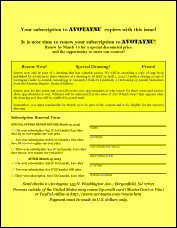 The
Winter issue of AVOTAYNU is in the mail. When you receive your copy, if
the subscription is about to expire, there is a yellow renewal form
included with the issue. Select a one-, two- or three-year renewal by
the March 15 deadline and participate in a contest whose prize is a
copy of any book published by Avotaynu. The
Winter issue of AVOTAYNU is in the mail. When you receive your copy, if
the subscription is about to expire, there is a yellow renewal form
included with the issue. Select a one-, two- or three-year renewal by
the March 15 deadline and participate in a contest whose prize is a
copy of any book published by Avotaynu. Special offer to new subscribers. Order a 2013 subscription to AVOTAYNU at http://www.avotaynu.com/journal4.htm, and we will send you a copy of the just-published Winter issue at no additional charge. Five issues of AVOTAYNU for the price of four. This offer ends next Saturday, February 23.
|
|||||||
| Nu?
What's New?
is published weekly
by Avotaynu, Inc. Copyright 2013, Avotaynu, Inc. All rights reserved To change an e-mail address, send a request to nuwhatsnew@earthlink.net To subscribe to AVOTAYNU, The International Review of Jewish Genealogy, go to http://www.avotaynu.com/journal.htm To order books from our catalog, go to http://www.avotaynu.com/catalog.htm To contact us by postal mail, write: Avotaynu, Inc.; 155 N. Washington Ave.; Bergenfield, NJ 07621 Telephone (U.S.) : 201-387-7200 |
|||||||
