|
Nu?
What's New? Gary Mokotoff, Editor Volume 14, Number 28 | July 14, 2013Every
government puts value on preserving its history. That is why we have
national archives. Genealogy preserves history; the history of a
family. It cannot be done without access to records, just as historians
cannot preserve a nation's history without access to records. It is a
greater good than the right to privacy. It is a greater good than the
risk of identity theft.
Past issues of Nu? What's New? are
archived at http://www.avotaynu.com/nu.htm
|
||
|
A summer week lean with information.
FamilySearch Immigration Indexing Project Reaches 50 Million Records  In
June, the FamilySearch U.S. Immigration Project reached a significant
milestone—50 million passenger ship and naturalization records
have been indexed. This is in addition to the 25 million Ellis Island
records indexed years ago, before FamilySearch indexing started. More
than 165,000 volunteers have participated in the project including
groups from the Federation of Genealogical Societies, National
Genealogical Society, the Association of Professional Genealogists, and
other societies. In
June, the FamilySearch U.S. Immigration Project reached a significant
milestone—50 million passenger ship and naturalization records
have been indexed. This is in addition to the 25 million Ellis Island
records indexed years ago, before FamilySearch indexing started. More
than 165,000 volunteers have participated in the project including
groups from the Federation of Genealogical Societies, National
Genealogical Society, the Association of Professional Genealogists, and
other societies.FamilySearch states they still have 60 million more U.S. immigration records and naturalization documents (at both the federal and county level) left to index. Current projects include: • Hawaii, Honolulu—Passenger Lists, 1900–1952 • Massachusetts, Boston—Crew Lists, 1891–1957 • New York—Passenger Lists, 1875–1891 • Texas, Del Rio—Alien Arrivals, 1906–1953 Projects coming soon: • Connecticut—Naturalizations, 1851–1992 • Rhode Island—Naturalizations, 1906–1991 • Maryland, Baltimore—Passenger Lists, 1820–1897 • New England—Naturalizations, 1787–1931 The complete story is at https://familysearch.org/blog/en/immigration-project-milestone. Lost Synagogues of New York City 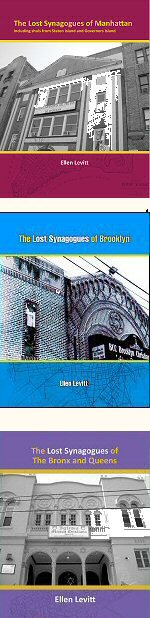 One
of the interesting aspects of Ellen Levitt’s trilogy about the
lost synagogues of New York City is comparing the structures in the
different boroughs of the City. By far, Brooklyn had the most
attractive synagogues, then Queens, then The Bronx. In the case of her
latest book, The Lost Synagogues of Manhattan,
a remarkable number of buildings appear outwardly as tenement
buildings. No doubt the earliest Eastern European Jewish immigrants
were merely looking for a place to pray, and attractiveness of the
synagogue was not a consideration (nor could they afford to build a
beautiful structure). My grandfather prayed in a shtiebel—a room
on the first floor of the tenement building where he lived on the Lower
East Side of Manhattan. As Jews acquired wealth in the Goldene
Medina (Golden Land), they migrated to the other boroughs of New
York City and
built beautiful synagogues. Those Jews that remained in Manhattan also
created comparable edifices. One
of the interesting aspects of Ellen Levitt’s trilogy about the
lost synagogues of New York City is comparing the structures in the
different boroughs of the City. By far, Brooklyn had the most
attractive synagogues, then Queens, then The Bronx. In the case of her
latest book, The Lost Synagogues of Manhattan,
a remarkable number of buildings appear outwardly as tenement
buildings. No doubt the earliest Eastern European Jewish immigrants
were merely looking for a place to pray, and attractiveness of the
synagogue was not a consideration (nor could they afford to build a
beautiful structure). My grandfather prayed in a shtiebel—a room
on the first floor of the tenement building where he lived on the Lower
East Side of Manhattan. As Jews acquired wealth in the Goldene
Medina (Golden Land), they migrated to the other boroughs of New
York City and
built beautiful synagogues. Those Jews that remained in Manhattan also
created comparable edifices.Each of the three books Levitt created typically has about 80 featured former Jewish houses of worship that includes a photograph of the building showing how it appears today, a narrative that explains the history of the building and, in some cases, interviews with former congregants. Additional information including the Table of Contents, sample page and a complete list of synagogues identified in each of the three books can be found at: Manhattan: http://avotaynu.com/books/LostSynagoguesManhattan.htm Brooklyn: http://avotaynu.com/books/LostSynagogues.htm Bronx/Queens: http://avotaynu.com/books/LostSynagoguesBronxQueens.htm The cost of each book is $26.00 plus shipping. There are special offers. Purchase all three books for $52.00 plus shipping (that is equivalent of buying two and getting one free). Purchase any two books for $40.00 plus shipping. Lithuanian Internal Passport Indexing Project Reaches 116,000 The LitvakSIG Internal Passport Project (1919–1940) has now indexed 116,191 records. For the period 1919–1940, every Lithuanian citizen age 17 or older was required to have an internal passport. They are called “internal passports” because they could only be used for travel within Lithuania. In reality, they were personal identification documents that proved the person was a Lithuanian citizen. They are a valuable genealogical resource because they include name, date/place of birth, address, nationality, religion, occupation, some special traits (if the person had any), family status, information about children. There is an 18-month delay between the date the data is extracted and the date they are available to the public at no charge. The information is more readily available if a person contributes money or time to the project. Complete information can be found at http://www.jewishgen.org/databases/Lithuania/InternalPassports.htm. Ellis Island Myth A posting to the JewishGen Discussion Group notes that there is an excellent article published by the New York Public Library about the myth that immigrants’ names were changed at Ellis Island at http://www.nypl.org/blog/2013/07/02/name-changes-ellis-island.
|
||
| Nu?
What's New?
is published weekly
by Avotaynu, Inc. Copyright 2013, Avotaynu, Inc. All rights reserved To change an e-mail address, send a request to nuwhatsnew@earthlink.net To subscribe to AVOTAYNU, The International Review of Jewish Genealogy, go to http://www.avotaynu.com/journal.htm To order books from our catalog, go to http://www.avotaynu.com/catalog.htm To contact us by postal mail, write: Avotaynu, Inc.; 794 Edgewood Ave.; New Haven, CT 06515 Telephone (U.S.) : 475-202-6575 |
||
