|
Nu?
What's New? Gary Mokotoff, Editor Volume 16, Number 29 | July 26, 2015Every
government puts value on preserving its history. That is why we have
national archives. Genealogy preserves history; the history of a
family. It cannot be done without access to records, just as historians
cannot preserve a nation's history without access to records. It is a
greater good than the right to privacy. It is a greater good than the
risk of identity theft.
Past issues of Nu? What's New? are
archived at http://www.avotaynu.com/nu.htm
|
||
|
Underlined words are links to
sites with additional information.
Is Sharing of Databases By Online Genealogical Companies Good for Genealogy?  I
have previously reported—with some excitement—that the
sharing of databases between the various online genealogical data
companies is a good idea for genealogy. Just this past week Mocavo
announced that, thanks to their partnership with FamilySearch, Mocavo
members now can access information from more than 22 million family
trees submitted by FamilySearch users—some 860M new records. I
have previously reported—with some excitement—that the
sharing of databases between the various online genealogical data
companies is a good idea for genealogy. Just this past week Mocavo
announced that, thanks to their partnership with FamilySearch, Mocavo
members now can access information from more than 22 million family
trees submitted by FamilySearch users—some 860M new records. But is this good for genealogical researchers? A significant downside is that searching for information about particular ancestors gets identical results on different sites which clouds the search for unique results. Now searching Mocavo for their unique records includes results from the “Family Search Tree,” but those records were already found on FamilySearch. Some of the companies sharing records with FamilySearch, a free-of-charge site, are charging for these same records on their fee-for-service site. Imagine the neophyte researcher paying for a record on Mocavo that is available at no charge on FamilySearch. Currently Mocavo has an even more peculiar circumstance. If you go to their home page and search for an individual—let’s say “Tobiasz Mokotow”— and find records from FamilySearch Tree, you cannot retrieve the information without a subscription. But if you go directly to the FamilySearch Tree database on Mocavo at http://tinyurl.com/MocavoFamilySearchTree, the information is available at no charge. Social Security Death Index Has New Companion: Social Security Applications and Claims Index  One
of the earliest collections on Ancestry.com is the Social Security
Death Index (also called Death Master File) which identifies more than
89 millions persons who died in the U.S. from about 1962–2014
(some earlier deaths also exist). Now Ancesty.com has added a second
database called the Social Security Applications and Claims Index
(1936–2007). The source of this information is the actual
application or claims process, and usually includes such valuable
details as birth date, birth place, and parents’ names, including
maiden name of mother. One
of the earliest collections on Ancestry.com is the Social Security
Death Index (also called Death Master File) which identifies more than
89 millions persons who died in the U.S. from about 1962–2014
(some earlier deaths also exist). Now Ancesty.com has added a second
database called the Social Security Applications and Claims Index
(1936–2007). The source of this information is the actual
application or claims process, and usually includes such valuable
details as birth date, birth place, and parents’ names, including
maiden name of mother.The database is located at http://search.ancestry.com/search/db.aspx?dbid=60901. Complete results are available to paid subscribers only. Ancestry.com Adds More Than 100 Years of Canadian Yearbooks Ancestry.com has just added Canadian school yearbooks from 1908–2010 to their collection. It includes middle school, junior high, high school and university records from almost 800 institutions across the nation. Included are McGill University and the University of Toronto. They can be found at http://search.ancestry.com/search/db.aspx?dbid=60576. Significant FamilySearch Additions  It
has been a while since FamilySearch has announced additions to their
collections. Based on their new announcement, it isn’t because
they were on vacation for the summer. A list of recent additions to
FamilySearch can be found at the Eastman Online Genealogy Newsletter at http://blog.eogn.com/2015/07/23/new-familysearch-collections-week-of-july-13-2015. It
has been a while since FamilySearch has announced additions to their
collections. Based on their new announcement, it isn’t because
they were on vacation for the summer. A list of recent additions to
FamilySearch can be found at the Eastman Online Genealogy Newsletter at http://blog.eogn.com/2015/07/23/new-familysearch-collections-week-of-july-13-2015. Many of the additions may be of value to Jewish genealogy research. Below is a list of just those items where millions of records have been added to their index. Find links to these collections at the Eastman site. • BillionGraves Index 1.5M added to existing collection • Brazil São Paulo Immigration Cards (1902–1980) 1.6M added • California Death Index (1905–1939) 2M added • Delaware Vital Records (1680–1971) 600K added • Illinois County Marriages (1810–1934) 500K added • Iowa State Census Index 1925 5.5M in new collection • Kentucky Vital Record Indexes (1911–1999) 9.8M in new collection • Massachusetts Boston Passenger Lists Index (1899–1940) 1.5M added • Michigan Obituaries (1820–2006) 1.4M added • Tennessee County Marriages (1790–1950) 3M added • Vermont St. Albans Canadian Border Crossings (1895–1924) 6.7M added Note that the last-mentioned item—Canadian Border Crossings—apparently includes entries beyond 1924. The entry of a family member in 1950 is included. These are some of the additional images added: • Germany Saxony Dresden Citizens’ Documents and Business Licenses (1820–1962) 856K added • Numerous Italian civil registration records • Tennessee County Marriages (1790–1950) 1.8M added • Vermont Town Clerk Vital and Town Records (1732–2005) 459K added Family Tree Magazine Names 101 Best Websites for Genealogy for 2015  For the 16th consecutive year, Family Tree Magazine
named its 101 best websites for genealogy. JewishGen, GenealogyIndexer
and Avotaynu are listed in the “Best Continental European
Genealogy Websites” category and the Stephen P. Morse One-Step
site is identified in “Best Online Genealogy Tools in 2015.”
For the 16th consecutive year, Family Tree Magazine
named its 101 best websites for genealogy. JewishGen, GenealogyIndexer
and Avotaynu are listed in the “Best Continental European
Genealogy Websites” category and the Stephen P. Morse One-Step
site is identified in “Best Online Genealogy Tools in 2015.”JewishGen, GenealogyIndexer and Avotaynu are misplaced since it implies these sites are limited to Continental European genealogy, when in reality, they cover the entire world. There is no appropriate category. Additional information is at http://familytreemagazine.com/article/101-Best-Websites-2015. GenealogyInTime Announces/Ranks Top 100 Genealogy Sites  Simultaneously, the online magazine GenealogyInTime
announced its top 100 genealogy sites with comparison to last
year’s ranking. Ancestry.com remains on top of the list.
FamilySearch is now second, just passing FindAGrave which was second
last year. The rankling is based on the estimate number of visitors in
the past year.
Simultaneously, the online magazine GenealogyInTime
announced its top 100 genealogy sites with comparison to last
year’s ranking. Ancestry.com remains on top of the list.
FamilySearch is now second, just passing FindAGrave which was second
last year. The rankling is based on the estimate number of visitors in
the past year. GenealogyInTime states that the top ten websites are important to look at in detail because they receive about 42% of the traffic to all the genealogy websites. They also state that the number of people visiting daily the 100 genealogy websites grew from 340,000 in 2014 to 356,000 in 2015. JewishGen ranked the same as last year: 33. The Stephen P. Morse site dropped from 35th to 55th. The complete ranking is shown at http://www.genealogyintime.com/articles/top-100-genealogy- websites-of-2015-page02.html. The pages that follow give additional statistics about online genealogy sites. Dictionary of Sephardic Given Names Has Been Shipped  Orders for Avotaynu’s most recently published book, Dictionary of Sephardic Given Names
have been shipped. The book contains nearly 2,000 Sephardic given names
that have been compiled by the author, Mathilde Tagger, from hundreds
of sources.
Orders for Avotaynu’s most recently published book, Dictionary of Sephardic Given Names
have been shipped. The book contains nearly 2,000 Sephardic given names
that have been compiled by the author, Mathilde Tagger, from hundreds
of sources. A typical entry includes: • Name: In the case of a variant or a diminutive, the root name is also shown. • Gender: Masculine or feminine—not always obvious from the name itself • Etymology: The origin of the name. • Variants: When they exist, they are part of the root name entry. • Place: When a name is peculiar to a specific geographic area, the area is indentified. • Source: The source where the name was found. • Diminutives: If existing, they are part of the root name entry. It is 166 pages and costs $24.00 plus shipping. Additional information and how to order can be found at http://www.avotaynu.com/books/SephardicGivenNames.html. FEEFHS Conference in Salt Lake City August 13–15 The Foundation for East European Family History Studies (FEEFHS) will hold their annual conference August 13–15 in Salt Lake City at the Salt Lake Plaza Hotel. Topics of interest to Jewish genealogists include: • Diane Afoumado, Chief, Research and Reference Branch, U.S. Holocaust Memorial Museum, will give the keynote address: “How the Records of the International Tracing Service (ITS) May Surprise You,” along with three case study presentations: Jewish, Polish, and German. • Ina Navazelskis, Project Coordinator at the Holocaust Memorial Museum, will present a talk about the “Oral History Interview Collection” of the museum as well as “How to Conduct Oral History Interviews.” • Joanne Sher will lecture on “Basics of Jewish Research,” “Beyond the Basics,” “Hebrew Translating for Headstones,” and “Holocaust Research.” The conference also offers a full track on German research, from basics to advanced topics; Russian research, Polish, and Germans from Russia. The 3-day conference is preceded by two workshops. One, presented by Joanne Sher, discusses “Finding the Village of Origin” for your ancestor. The complete program is at http://feefhsworkshop.org/program/schedule. If you are of Central or Eastern European origin and are unfamiliar with FEEFHS, their site at http://feefhs.org is worth a visit. They have an extensive collection of maps of Central and Eastern Europe at http://feefhs.org/maplibrary.html. Their Genealogical Resource Directory provides links to sites providing information about genealogical research for virtually every country in Europe. The Foundation for Eastern European Family History Studies (FEEFHS) was founded in 1992 to provide access to genealogical resources and educational programs relating to Eastern European family history research.  Join IAJGS 2016 Conference Blog
The embers of the recently completed 35th IAJGS International Conference on Jewish Genealogy are not cool yet, but the planners for the 2016 conference in Seattle, Washington, August 7–12, have already created a blog at http://www.iajgs2016.org/blog. Go to the site and subscribe to the blog to receive information about the conference as it develops. New Book: Endogamy: One Family, One People  Professional
genealogist Israel Pickholtz is about to publish a book that addresses
the problem of DNA testing among Jews titled Endogamy: One Family, One People.
Endogamy, the act of marrying within your own kind, plagues Jewish DNA
research because it often creates the illusion that every Jew is
closely related to every other. The fact that Jews have been marrying
each other for hundreds of years means that all Jews are related to
each other multiple times from the same ancestors. That is in addition
to the more familiar “my great-grandparents were cousins.” Professional
genealogist Israel Pickholtz is about to publish a book that addresses
the problem of DNA testing among Jews titled Endogamy: One Family, One People.
Endogamy, the act of marrying within your own kind, plagues Jewish DNA
research because it often creates the illusion that every Jew is
closely related to every other. The fact that Jews have been marrying
each other for hundreds of years means that all Jews are related to
each other multiple times from the same ancestors. That is in addition
to the more familiar “my great-grandparents were cousins.”This phenomenon makes it very difficult to attribute bits of DNA to particular relationships in the way that non-endogamous families can. Pickholtz attacked the problem using his own families, achieving no small number of successes, and they are described in the book. The book shows how he selected family members to test and how the results enabled him to determine the probable families of his ancestors. The book is 224 pages and retails for $35.00, currently with a prepublication discount. Additional information can be found at http://www.endogamy-one-family.com. Book on Jews of Charleroi, Belgium, at Outset of WWII 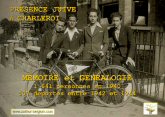 Vincent
Vagman has published a book that lists the Jews of Charleroi, Belgium,
at the outset of World War II. There were 1,641 Jews, of whom 507 were
deported between 1942 and 1944. Vagman has placed on his website, http://www.zakhor-belgium.com, a scanned copy of the book with a search engine. It is located at http://www.zakhor-belgium.com/fr/genealogistes/ ancetres-juifs-a-charl.
It uses the Calaméo publishing platform. For those not familiar
with how that operates, go to the site of the book. Click the icon in
the upper right corner to change to full screen and page through the
book. The magnifying glass icon allows you to do a full-word search of
the book. I recommend that you browse the book rather than use the
search engine because of the many spelling variants of a given surname.
Results provide detailed information about the person. Vincent
Vagman has published a book that lists the Jews of Charleroi, Belgium,
at the outset of World War II. There were 1,641 Jews, of whom 507 were
deported between 1942 and 1944. Vagman has placed on his website, http://www.zakhor-belgium.com, a scanned copy of the book with a search engine. It is located at http://www.zakhor-belgium.com/fr/genealogistes/ ancetres-juifs-a-charl.
It uses the Calaméo publishing platform. For those not familiar
with how that operates, go to the site of the book. Click the icon in
the upper right corner to change to full screen and page through the
book. The magnifying glass icon allows you to do a full-word search of
the book. I recommend that you browse the book rather than use the
search engine because of the many spelling variants of a given surname.
Results provide detailed information about the person.TheGenealogist Adds 100K Records of London Synagogue Seat Holders  TheGenealogist
has released online 99,500 records of London synagogue seat holders
spanning the years from 1920 to 1939. It covers records from 18
synagogues around London with many connected guilds, societies,
charities, etc. Information found in these records includes names of
men eligible for office, life member of the council, women who are seat
holders in their own right and seat holders who are not eligible to
vote. The site is fully searchable by name, keyword, synagogue and
address. TheGenealogist is a fee-for-service site. The announcement can
be found at http://www.thegenealogist.com/news/#latest. Note: This link may expire over time. TheGenealogist
has released online 99,500 records of London synagogue seat holders
spanning the years from 1920 to 1939. It covers records from 18
synagogues around London with many connected guilds, societies,
charities, etc. Information found in these records includes names of
men eligible for office, life member of the council, women who are seat
holders in their own right and seat holders who are not eligible to
vote. The site is fully searchable by name, keyword, synagogue and
address. TheGenealogist is a fee-for-service site. The announcement can
be found at http://www.thegenealogist.com/news/#latest. Note: This link may expire over time.  Additions to American Jewish Joint Distribution Committee Names Index
American Jewish Joint Distribution Committee has indicated they have added new lists of clients they assisted in Australia, France and Sweden. Search their names index at http://archives.jdc.org/. A list of all items in their collection is at http://archives.jdc.org/explore- the-archives/searchable-lists.html. FindMyPast Adding 1939 Register of UK  Findmypast
in partnership with the UK National Archives is publishing the 1939
Register online. As Britain faced the certainty of war that year,
householders were given a card to fill out answering questions that
would give the government a breakdown of the population and assess
their needs. This information would then help in such matters as
identity cards, rationing, conscription and more. The Census Act of
1920 provides that no UK census can be made available for the public to
view until 100 years after being taken. Due to World War II, there is a
30 year gap between available censuses. This is significant, as it
means a three decade-long gap between surviving censuses. The 1939
Register bridges that gap. Findmypast
in partnership with the UK National Archives is publishing the 1939
Register online. As Britain faced the certainty of war that year,
householders were given a card to fill out answering questions that
would give the government a breakdown of the population and assess
their needs. This information would then help in such matters as
identity cards, rationing, conscription and more. The Census Act of
1920 provides that no UK census can be made available for the public to
view until 100 years after being taken. Due to World War II, there is a
30 year gap between available censuses. This is significant, as it
means a three decade-long gap between surviving censuses. The 1939
Register bridges that gap.To be informed about the progress of the project, sign up at http://www.findmypast.co.uk/1939register. Annual European Days of Jewish Culture Is September 6  The
16th European Days of Jewish Culture will take place this September
2015 under the motto “Bridges.” Participating countries
include Austria, Croatia, Denmark, France, Georgia, Germany, Greece,
Hungary, Lithuania, Netherlands, Norway, Romania, Serbia, Slovenia,
Spain, Switzerland, Turkey and United Kingdom. Events will occur in
these countries which may include tours of Jewish heritage sites,
concerts, lectures, exhibitions, performances, book fairs, food
tastings, etc. Some of the national programs are already online. The
16th European Days of Jewish Culture will take place this September
2015 under the motto “Bridges.” Participating countries
include Austria, Croatia, Denmark, France, Georgia, Germany, Greece,
Hungary, Lithuania, Netherlands, Norway, Romania, Serbia, Slovenia,
Spain, Switzerland, Turkey and United Kingdom. Events will occur in
these countries which may include tours of Jewish heritage sites,
concerts, lectures, exhibitions, performances, book fairs, food
tastings, etc. Some of the national programs are already online. Loosely coordinated by the European Association for the Preservation and Promotion of Jewish Culture and Heritage in Europe (AEPJ), the European Day of Jewish Culture grew out of a conference on the future of Jewish heritage in Europe held in Paris in 1999, and developed from the model of an "Open Doors" to Jewish heritage that had been begun in Alsace-Loraine in 1996. Additional information is at http://tinyurl.com/EJDC2015.
|
||
| Nu?
What's New?
is published weekly
by Avotaynu, Inc. Copyright 2015, Avotaynu, Inc. All rights reserved To change an e-mail address, send a request to nuwhatsnew@earthlink.net To subscribe to AVOTAYNU, The International Review of Jewish Genealogy, go to http://www.avotaynu.com/journal.htm To order books from our catalog, go to http://www.avotaynu.com/catalog.htm To contact us by postal mail, write: Avotaynu, Inc.; 794 Edgewood Ave.; New Haven, CT 06515 Telephone (U.S.) : 475-202-6575 |
||
