|
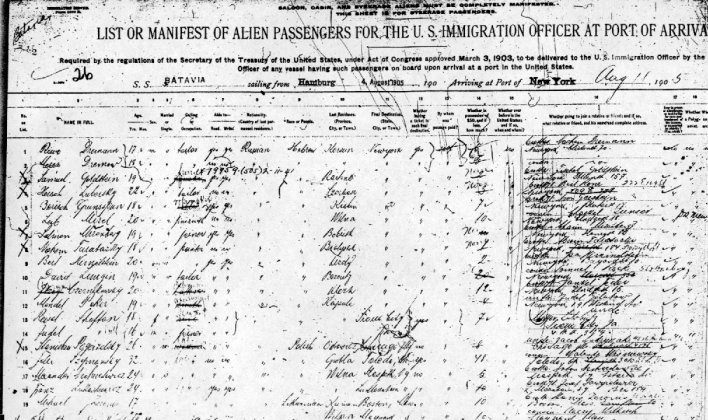
Passsenger Arrival Records Since the early 19th century, ships arriving in the United States were required to document the names of all passengers and submit them to customs/immigration authorities upon arrival. Early manifests contained little information other than the name of the passenger, age, occupation and country of citizenship. Starting in 1904, it included additional information about alien passengers such as address where passenger was going and name and name/address of person in country where passenger came from. Most valuable of all was place of birth; both town and country. Shown above (line 8) is the arrival record of Nuchem (Menachem) Tartasky, the son of Yechakel Tartasky and grandfather of a number of family members living in the U.S. He arrived on the Batavia on August 11, 1907. It says he is 18, a painter, and was going to 184 Forsythe Street in New York. Passenger arrival records are one of the most valuable resources for genealogy. This is especially true of the post 1907 period when many questions werre asked of the immigrant. It provides the age of the passenger, which may lead to the birth record. It identifies both the town from which the immigrant came as well as his/her place of birth (town and country). Familial relatonships can be determined by analyzing the name of the person given in the country from which the immigrant came and the name and address of the person to whom the immigrant was going. Thus the arrival of a mother with children usually gives the name and address of the husband in the U.S. who preceded her in coming to the U.S. It may show the mother's father as the person in the country from which she came. |