|
Nu?
What's New? Gary Mokotoff, Editor Volume 21, Number 5 | February 2, 2020 Every
government puts value on preserving its history. That is why we have
national archives. Genealogy preserves history; the history of a
family. It cannot be done without access to records, just as historians
cannot preserve a nation's history without access to records. It is a
greater good than the right to privacy. It is a greater good than the
risk of identity theft.
Past issues of Nu? What's New? are
archived at http://www.avotaynu.com/nu.htm
|
||
|
Underlined words are links to
sites with additional information.
Arolsen Archives Places DP Registration Cards for 1.7M People Online  Arolsen
Archives has placed online a collection of documents containing
registration cards for 1.7M Displaced Persons. The Archives states,
“These cards contain a wealth of information about these
people’s backgrounds and paths of persecution as well as
about their situation after 1945: Where did these people want to
emigrate to? Where were their temporary places to stay in the
meantime?” Arolsen
Archives has placed online a collection of documents containing
registration cards for 1.7M Displaced Persons. The Archives states,
“These cards contain a wealth of information about these
people’s backgrounds and paths of persecution as well as
about their situation after 1945: Where did these people want to
emigrate to? Where were their temporary places to stay in the
meantime?”Their collection can be searched at https://arolsen-archives.org/en/search-explore/ search-online-archive/. MyHeritage Plans 24-Hour Genealogy Webinar Marathon  MyHeritage,
in conjunction with Legacy Family Tree Webinars, will present 24
consecutive webinars in a 24-hour genealogy webinar marathon starting
March 12 at 5pm Eastern U.S. time. This session is open to all and free
of charge. MyHeritage,
in conjunction with Legacy Family Tree Webinars, will present 24
consecutive webinars in a 24-hour genealogy webinar marathon starting
March 12 at 5pm Eastern U.S. time. This session is open to all and free
of charge.Some of the sessions are on general topics and, therefore, of interest to many. They include: • How Do I Know It's Correct: Evidence and Proof • Advanced Googling for Your Grandma • Emigration via Hamburg • The Coded Census: Deciphering U.S. Census • Advanced Features of MyHeritage.com Additional information is available at https://familytreewebinars.com/intermediate_page. php?diply_nm=24. It includes a link to the registration page. New Book: Getting Started in Jewish Genealogy: 2020 Edition 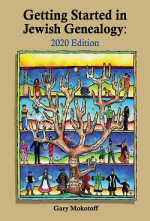 Avotaynu
has just published the 2020 version of Getting Started in Jewish
Genealogy. The book has been regularly updated since 2010
because of the dynamic growth of Jewish genealogy research. Avotaynu
has just published the 2020 version of Getting Started in Jewish
Genealogy. The book has been regularly updated since 2010
because of the dynamic growth of Jewish genealogy research. It is not a beginner’s guide, but a primer to demonstrate that there is a world of records and resources to help you to trace your Jewish family history. The book is only 104 pages, making it quick reading, yet it holds a wealth of information. An appendix includes a case study to demonstrate that tracing your Jewish ancestry can be done. The appendix documents how the book’s author traced the ancestry of the notorious Bernie Madoff back six generations using only internet resources. It includes the challenge that the name was changed to Madoff “at Ellis Island.” Additional information, including the Table of Contents, is available at http://www.avotaynu.com/books/GettingStarted.htm. The price is $16.50 plus shipping. Avotaynu offers the book to Jewish genealogical societies at half price when at least 20 copies are ordered. Some societies distribute the book at no charge to new members who are starting to research their Jewish roots. Others use it as part of beginners’ workshops. 14 Ways to Find Your Ancestors Address  Trying
to locate the exact address where a person lived at a certain time? The
Ancestor Hunt has published an essay titled “14 Ways to Find
Your Ancestors Address” that might be of assistance. It is
oriented toward American research, but many of the suggestions apply to
any country. Trying
to locate the exact address where a person lived at a certain time? The
Ancestor Hunt has published an essay titled “14 Ways to Find
Your Ancestors Address” that might be of assistance. It is
oriented toward American research, but many of the suggestions apply to
any country. The article can be found at https://tinyurl.com/AH14Ways. RootsTech 2020 Announces Its Free Online Streaming Schedule  RootsTech
2020 has announced its free online streaming schedule. Starting
February 26 at 8am MDT, a select number of classes and events,
including the daily keynote speakers, will be broadcast live at
RootsTech.org. Sessions will be available to view on-demand after the
livestream ends. RootsTech
2020 has announced its free online streaming schedule. Starting
February 26 at 8am MDT, a select number of classes and events,
including the daily keynote speakers, will be broadcast live at
RootsTech.org. Sessions will be available to view on-demand after the
livestream ends. Interested parties can also purchase or add on a Virtual Pass to get access to 30 recorded classes from the event. These add-on classes will not be livestreamed but will be recorded and published 15 to 20 days following the end of the conference and will be available only to Virtual Pass holders. View the streaming schedule at https://www.rootstech.org/salt-lake/live-stream-schedule. Information about the Virtual Pass can be found at https://www.rootstech.org/salt-lake/virtual-pass. RootsTech will be held February 26–February 29 at the Salt Palace Convention Center in Salt Lake City, Utah. In 2019, the event attracted more than 20,000 attendees from all 50 U.S. states and 38 different countries. The conference will feature more than 300 sessions, including hands-on computer workshops taught by industry professionals; interactive activities and helpful exhibitors in the expo hall; and entertaining events. RootsTech is hosted by FamilySearch. New Feature: Central Database of Shoah Victims' Names Database Now Clusters Records for Same Individual ===  The
Central Database of Shoah Victims' Names at https://yvng.yadvashem.org/
documents some 4.8 million Holocaust victims. Sometimes it has more
than one record for the same person. Yad Vashem has upgraded their site
so that now it can graphically show together name records referring to
the same victim/individual (a cluster). Next to each cluster a number
indicates how many name records are included; each record can then be
viewed separately. The
Central Database of Shoah Victims' Names at https://yvng.yadvashem.org/
documents some 4.8 million Holocaust victims. Sometimes it has more
than one record for the same person. Yad Vashem has upgraded their site
so that now it can graphically show together name records referring to
the same victim/individual (a cluster). Next to each cluster a number
indicates how many name records are included; each record can then be
viewed separately. The new interface allows toggling between two views of the same database: one showing, when relevant, the records grouped/clustered together under the name of a specific victim, and one showing the view of every record separately as in the previous interface. The new interface was also designed to allow users of the Names Database to notify of additional cases of multiple records that were not yet identified. A more detailed description, with illustrations, will appear in the Winter issue of AVOTAYNU which will be published in about two weeks. Amazing NARA Statistics  To understand the
enormity of the collection at the U.S. National Archives and Records
Administration (NARA), the institution recently published some
statistics about its holdings. As of January 2020, NARA has 96,520,910
scans online representing 0.841% of the estimated total number of
textual pages in its holdings. They estimate their holdings are
11,473,770,573 total textual pages. (I claim it is more likely to be
11,473,770,574.) To understand the
enormity of the collection at the U.S. National Archives and Records
Administration (NARA), the institution recently published some
statistics about its holdings. As of January 2020, NARA has 96,520,910
scans online representing 0.841% of the estimated total number of
textual pages in its holdings. They estimate their holdings are
11,473,770,573 total textual pages. (I claim it is more likely to be
11,473,770,574.)Learn more about these numbers at https://www.archives.gov/findingaid/explorer#rgnumbers. FamilySearch Adds 9.5 Million Records This Week  A
list of recent additions to FamilySearch, 9.5 million index records,
can be found at https://tinyurl.com/FamilySearch012720.
This site provides direct links to the individual collections. They
include records from American Samoa, Brazil, Canada, Chile, Colombia,
Denmark, England, Guatemala, Iceland, Peru, Puerto Rico, Sierra Leone,
South Africa, Spain, Sweden and the United States. A
list of recent additions to FamilySearch, 9.5 million index records,
can be found at https://tinyurl.com/FamilySearch012720.
This site provides direct links to the individual collections. They
include records from American Samoa, Brazil, Canada, Chile, Colombia,
Denmark, England, Guatemala, Iceland, Peru, Puerto Rico, Sierra Leone,
South Africa, Spain, Sweden and the United States. Included are: • more than 3.9M records from North Carolina marriages, deaths and burials (1759-1994) • 1M Massachusetts marriage records (1695-1910) • 1.9M New Jersey birth, marriage, and naturalization records • 570,349 Illinois marriages (1815–1935) • 1.25M New Jersey deaths and burials (1720–1988), marriages, (1678–1985), naturalization records, (1796–1991). Note that at the website, announced collections may not be complete for the dates specified and will be added at some later date. Also note that counts shown in the announcement are the number added, not the total number available in the collection, which can be greater. New Collections at Ancestry.com  Ancestry has
added/updated the following record groups at their site. The list with
links to individual collections can be found at https://www.ancestry.com/cs/recent-collections.
Announced collections may not be complete for the dates specified and
will be added at some later date. There is also no indication of how
many records were added to the updated collections. Ancestry has
added/updated the following record groups at their site. The list with
links to individual collections can be found at https://www.ancestry.com/cs/recent-collections.
Announced collections may not be complete for the dates specified and
will be added at some later date. There is also no indication of how
many records were added to the updated collections.New Collections Florida, Voter Registration Rolls, 1867–1868 UK, Register of Duties Paid for Apprentices' Indentures, 1710–1811 Victoria, Australia, Coroner Inquest Deposition Files, 1840–1925 Updated Collections Find A Grave Index for various countries
|
||
| Nu?
What's New?
is published weekly
by Avotaynu, Inc. Copyright 2020, Avotaynu, Inc. All rights reserved To change an e-mail address, send a request to info@avotaynu.com To subscribe to AVOTAYNU, The International Review of Jewish Genealogy, go to http://www.avotaynu.com/journal.htm To order books from our catalog, go to http://www.avotaynu.com/catalog.htm To contact us by postal mail, write: Avotaynu, Inc.; 794 Edgewood Ave.; New Haven, CT 06515 Telephone (U.S.) : 475-202-6575 |
||
